


Since Work Flows Through Email, It’s Too Valuable to Ignore.
Too many organizations think of email as a communication tool. In reality, it’s more like an operational system.
Customer escalations arrive there first. Managers approve budgets and hiring requests there. Legal discussions unfold there. Vendors negotiate timelines there. Sales teams handle objections there. HR documents sensitive cases there. Even in organizations that use dedicated project management and collaboration tools, much of the context behind major business decisions still lives in email.
That makes email-driven work one of the most under-leveraged sources of operational intelligence available to leaders today.
And the problem isn’t even that businesses have too much email, as commonly assumed. It’s that they often treat those messages as a passive vault rather than an opportunity for unprecedented workflow visibility.
Emails are kept around for compliance, searched when someone remembers they exist, and otherwise left scattered across thousands of individual inboxes. Over time, that creates costly operational blind spots. Decisions become difficult to reconstruct. Ownership becomes unclear. Institutional knowledge quietly builds up inside conversations that no one can keep track of.
Meanwhile, Microsoft reports that the average employee receives 117 emails on the average workday, is interrupted roughly every two minutes by meetings, messages, or notifications, and regularly communicates outside normal working hours. That’s an enormous volume of workforce communication data flowing through a single channel every day.
Without a way to convert that information into actionable business email insights, organizations are forced to get by on intuition and anecdote instead of evidence.
The Hidden Operational Costs of Email Blind Spots
Like all things operations, it takes more than just a missed email to get the dominoes falling. Organizational debt accumulates gradually, as everyday communication becomes harder to track, decisions lose context, and work slows in ways that aren’t immediately visible.
By the time the impact is obvious, the underlying issues have existed for months or even years.
Delays compound faster than leaders realize
Work moves at the speed of decisions.
When approvals, clarifications, and customer conversations stretch across multiple email threads, every additional handoff increases the chance that something slips through the cracks.
The American Productivity & Quality Center (APQC)’s study of 982 full-time knowledge workers helps put these seemingly innocuous delays into perspective. On average, respondents reported spending 3.6 hours each week managing internal workplace communication and another 2.8 hours looking for or requesting needed information, underscoring how communication friction quietly erodes productivity.
And on the ground, that might translate to:
- Client-facing teams experiencing slower service recovery.
- Operations teams spending more time coordinating than executing.
- Legal and compliance teams wasting valuable hours searching for records that should have been immediately available.
- Leadership noticing the outcome long before they understand the cause.
Institutional knowledge hides inside inboxes
We’ve all experienced the “tip-of-the-tongue” phenomenon, where you’re sure you know that word or important date but can’t recall it in the moment.
Organizations face something similar daily. The difference is that instead of a forgotten lyric, it’s a customer commitment, an approval, or the reasoning behind a business decision that’s now under scrutiny.
Employees frequently need to find knowledge trapped in inboxes before responding to customers, reviewing contracts, onboarding colleagues, or making basic operational decisions.
Because the messages still exist, but the visibility just… doesn’t, which creates duplicate work throughout the organization.
This is one of those sneaky time drains that eat into a workweek faster than you can say “Eureka!”
Executive Visibility ≠ Surveilling Everyone’s Inbox
There’s one question that keeps surfacing whenever we bring up business communication visibility:
“Can we understand how work flows across the organization without turning into Big Brother?”
Yes, you absolutely can, as those goals aren’t mutually exclusive. Workplace communication visibility, when done right, isn’t about watching every single employee like a hawk.
Instead of reviewing isolated messages or zeroing in on out-of-context behaviors, leaders can identify recurring patterns.
- Where’s the response-time drift?
- Where do approvals consistently stall?
- Which workflows depend heavily on one person?
- Which customer issues repeatedly require escalation?
- Which teams are consistently overloaded outside business hours?
Answering those questions requires organizational email analysis, not because leaders need to know the nitty-gritty of every conversation, but because recurring communication patterns reveal operational issues before traditional reporting does.
The objective is fewer surprises, not more oversight. Ultimately, this comes down to management. It’d be naive to assume every business will use communication analytics responsibly. But leaders interested in improving communication flow typically get far greater value from understanding organization-wide patterns than from examining individual contributors.
Email Is the Connective Tissue of Modern Work
The typical business has invested heavily in collaboration software, CRMs, ticketing systems, project management platforms, knowledge bases… You name it.
Yet email continues to connect all of them.
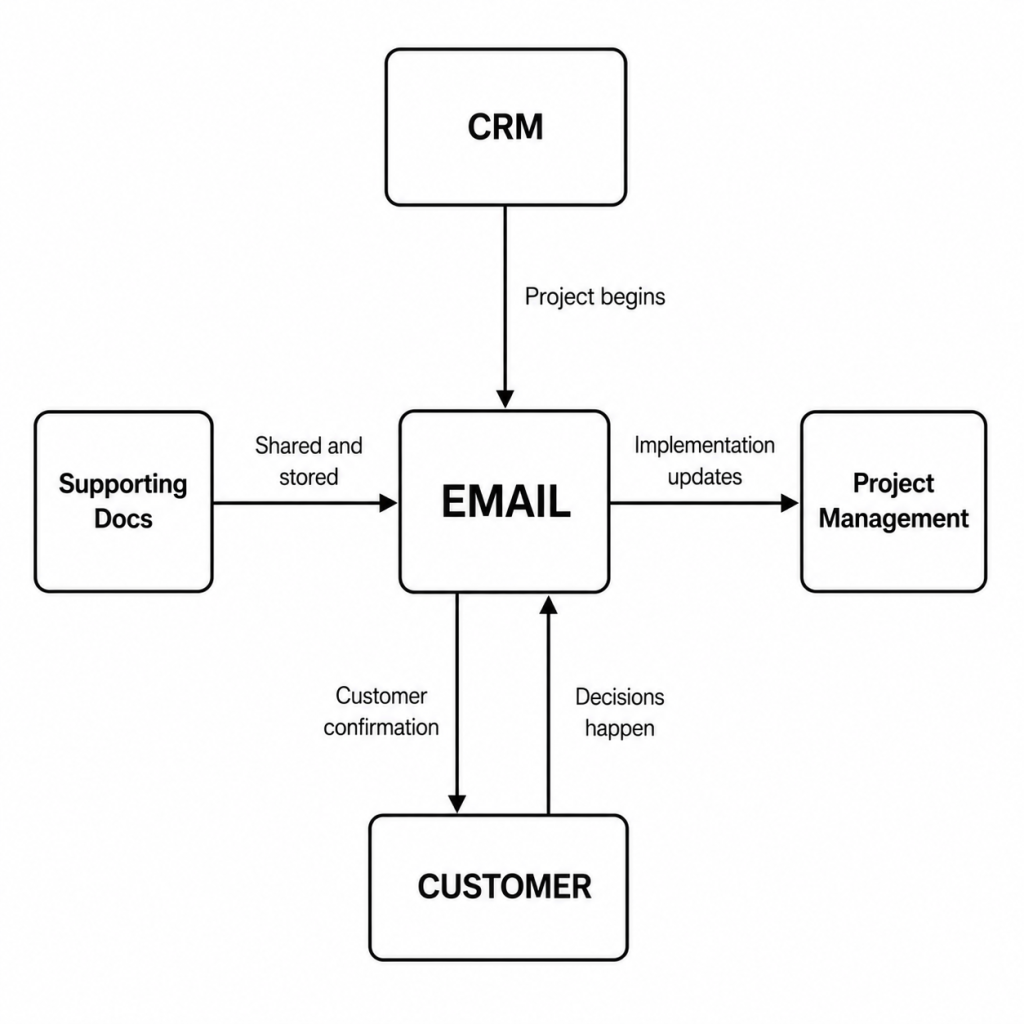
Eventually, organizations trying to improve team visibility across tools and departments discover that email provides the missing operational context.
Improving leadership visibility doesn’t mean taking a chainsaw to existing systems. It’s about understanding how the most critical central channel links them all together, and how to keep track of email tasks.
Without that context, leaders see disconnected activities rather than complete workflows (and a pretty complete data trail to go with them).
Alert Fatigue Makes Critical Signals Harder to See
Volume creates another hidden operational cost.
When employees receive well over 100 emails each day, every notification competes for attention. Security alerts, customer escalations, approval requests, project updates, newsletters, and automated system messages all arrive in the same place.
This creates a form of alert fatigue that’s risky beyond just cybersecurity.
Important operational signals become harder to distinguish from routine noise. That matters during customer escalations, compliance investigations, and service incidents, where delayed responses can increase both cost and business risk.
To course-correct, organizations may strive to “improve incident response notifications” (however measurable that is). But if people are already overwhelmed, anything less than an at-source fix will be insufficient.
Microsoft’s guidance instead focuses on reducing low-value alerts and adding enough context that the important ones stand out. The same idea applies to business communication: find and fix the upstream patterns creating the noise, not just the pings about it.
When Communication Blind Spots Become Business Problems
The average communication breakdown never makes the news, but the ones that do illustrate how seemingly ordinary coordination failures can escalate into costly consequences.
Communication breakdowns snowball into operational failures
Remember Southwest Airlines’ 2022 holiday scheduling meltdown? Nearly 17,000 flights were canceled after severe weather exposed weaknesses in the airline’s crew-scheduling systems and operational coordination. More than two million travelers were affected, customer support channels became overwhelmed, and the airline later reached a $140 million settlement with the Department of Transportation.
The lesson extends well beyond aviation. Operational failures begin with one catastrophic mistake Catastrophic mistakes result from a pile-on of little operational failures. Dozens or hundreds of small communication breakdowns accumulate without anyone seeing the broader pattern. Or maybe they’ll notice it as the Southwest Airlines Pilots Association (SWAPA) did but get ignored by their higher-ups.
Trusted communication channels can become hidden business risks
In what’s becoming something of a common occurrence, an engineering and manufacturing company sued a law firm and one of its members for “recklessly” transferring $1.1 million to fraudsters. The crafty attackers inserted fake wire instructions into an existing email conversation, exploiting a communication channel the law firm’s employees already trusted.
Email isn’t just where people exchange messages. It’s where authority is delegated, payments are approved, contracts are negotiated, and sensitive information changes hands. Without email intelligence, unusual communication patterns can look completely ordinary until seven figures of damage has already been done.
By and large, your business may never experience a crisis as cataclysmic as these. What might hit closer to home, though, are the dozens of smaller losses that quietly erode productivity and trust. Individually, they appear isolated. But viewed together, they reveal recurring communication trouble areas that deserve attention long before they become a headache.
Turning Email Into Operational Intelligence
Since email was invented as a communication medium, organizations have been treating it like just that… a communication medium and, if authorities require it, something to retain.
Forward-looking businesses, however, are beginning to treat it more like something they can learn from.
An email analytics platform helps bridge that gap by combining secure archiving with operational insight.
Org IQ combines immutable email capture with powerful search, reporting, sentiment analysis, AI-assisted tagging, employee-focused reporting, guest access, and analytics designed to help organizations understand communication patterns rather than simply exchange and preserve messages.
For executives, that translates to stronger communication insights into response-time trends, collaboration patterns, and workflow bottlenecks.
For HR, it means earlier operational visibility into communication changes that may warrant closer attention.
For Legal and Compliance, it means faster retrieval, stronger audit readiness, and less time spent reconstructing historical decisions.
Therein lies the hidden cost of email-driven work: operating without the visibility and intelligence needed to understand how work actually gets done.
Organizations that reduce those blind spots make faster decisions, preserve institutional knowledge, improve cross-functional collaboration, and solve problems while they’re still manageable rather than after they’ve become expensive.
Frequently Asked Questions
What is email-driven work?
Email-driven work refers to business processes that rely heavily on email for approvals, customer communication, coordination, decision-making, and knowledge sharing. For many organizations, email remains the primary record of how work gets done.
Why does workplace communication visibility matter?
Workplace communication visibility helps organizations identify patterns such as stalled approvals, repeated escalations, overloaded teams, and collaboration bottlenecks before they develop into larger operational or compliance issues.
How is email intelligence different from email search?
Email search retrieves known messages. Email intelligence analyzes communication patterns across many messages to surface operational trends, collaboration issues, and emerging risks that individual searches cannot reveal.
What does an email analytics platform do?
An email analytics platform like Org IQ combines searchable archives with reporting and communication analytics to transform everyday communication into actionable operational insight, helping organizations identify trends, reduce risk, and improve decision-making.
How can organizations find information trapped in email?
The first step is treating email like the organizational knowledge it is, not just personal correspondence. Searchable archives, structured tagging, and organizational email analysis make it easier to retrieve historical decisions, customer context, approvals, and other business-critical information without relying on individual memory.
How can businesses improve team visibility across tools?
Most organizations already use multiple systems for projects, documents, customer relationships, and collaboration. Improving visibility means connecting the communication layer between those systems so leaders can understand how work flows across the business rather than viewing each platform in isolation.


