


Organizational risks don’t appear overnight. Employee turnover, customer churn, compliance failures, operational bottlenecks, and fraud events are often preceded by weeks or months of smaller warning signs. The challenge for executives is recognizing those signals before they become formal incidents.
Some leaders rely on experience and instinct. Others use reporting, workforce analytics, customer feedback, or communication data to spot emerging issues. Many organizations combine all of the above, using AI and organizational intelligence tools to surface patterns that would otherwise remain hidden.
This blog post explores how executives detect organizational risk early, the communication signals that often appear first, and how leadership teams can combine judgment, data, and AI insight to make better decisions before problems escalate.
The communication patterns that matter first
The earliest operational risk signals show up in ordinary communication, long before they appear in a board pack or formal escalation.
- Response-time drift. Few organizational health metrics are as easy to dismiss as a slower reply, yet responsiveness is closely tied to how work gets done. Studies of workplace email behavior have found that high performers tend to respond more consistently, while changes in communication patterns are associated with burnout and disengagement. When previously reliable contributors begin replying later or stop taking clear ownership, something upstream might be starting to break.
- Stalled threads. Work moves at the speed of decisions. When email conversations stretch across repeated follow-ups, looping questions, and unresolved requests, they usually reveal a breakdown in ownership, authority, or process. Here, the thread content itself isn’t risky. The organizational friction keeping it at a snail’s pace is.
- Attrition clues. Employees rarely wake up one morning and decide to hand in their badge. Long before a resignation hits HR’s desk, engagement starts to fade in everyday exchanges. A study published in Computers in Human Behavior found that managers who later left their organizations exhibited measurable communication changes months beforehand, including weaker engagement and shifts in their position within workplace networks.
- After-hours overload. The average worker receives 117 emails per day, is interrupted every two minutes during core hours, and sends or receives more than 50 messages outside standard business hours. If extraordinary effort becomes ordinary, leaders might want to consider whether workload, staffing, or process design is being operated sustainably.
- Fraud and mishandling. The FBI’s 2024 IC3 report logged 21,442 business email compromise complaints and about $2.77 billion in losses. While these losses grab the headlines, the underlying lesson is more important: Email isn’t just where work gets done. It’s where approvals are granted, payments are authorized, and sensitive information changes hands, making it one of the clearest windows into operational risk.
Why instinct demands evidence
Instinct is often a leader’s first risk detection system. The question isn’t whether leaders should trust their gut. It’s how they should validate it.
As organizations grow, separating genuine risk from false alarms becomes trickier. What once felt obvious now requires a paper trail, context, and a way to determine whether a pattern is isolated or systemic.
Instinct is usually right about where to look
Gary Klein’s Recognition-Primed Decision (RPD) model suggests that experts often make decisions by recognizing patterns from prior experience rather than evaluating every possible option.
That helps explain why experienced leaders can sense organizational risk before it appears in a report. Years of exposure to customer issues, turnover, and operational failures make certain warning signs difficult to miss.
The problem is scale
As organizations grow, leaders lose direct access to many of the conversations that generate risk signals. Still, delayed responses, communication bottlenecks, disengagement, and customer friction remain visible in everyday interactions, so spotting them requires systems rather than observation alone.
So what’s a manager to do?
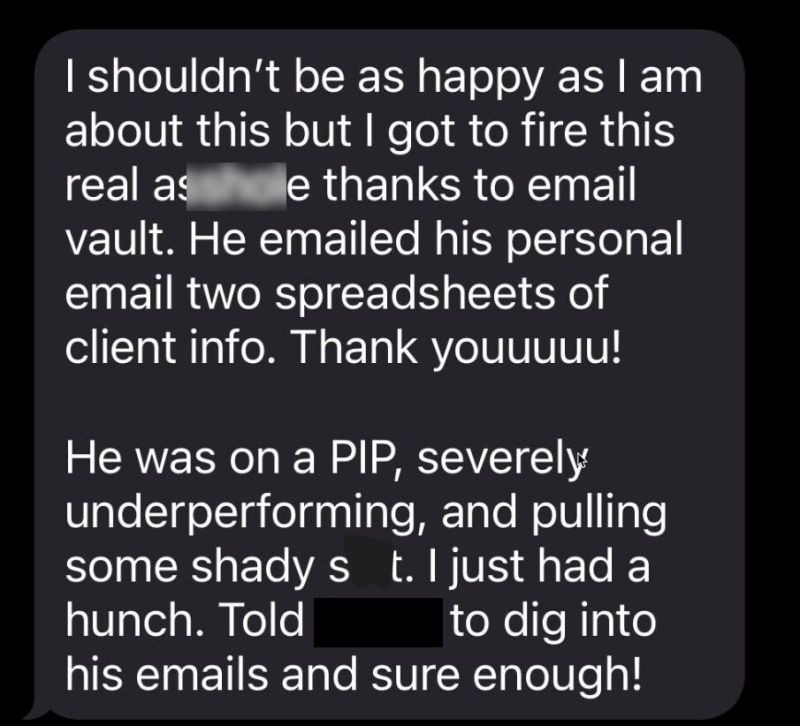
A hunch can start an investigation. It can’t justify a decision.
Whether the issue involves staffing, compliance, customer experience, or performance, evidence is key leadership decision support, determining whether that was an isolated incident or a broader trend. Evidence turns intuition from a feeling into something an organization can act on.
What executive visibility looks like in practice
Strong executive visibility ≠ reading everyone’s inbox. In an increasingly tech-enabled workplace, it often looks like summarizing weak signals into a small set of usable views that leaders can revisit, question, and act on.
- Track patterns, not incidents: Individual emails don’t tell leaders much. Risk becomes visible when the same signal appears repeatedly across teams, customers, or workflows. The goal is to identify trends upstream, before they become operational, cultural, or compliance problems.
- Measure work as it actually happens: Response delays, stalled decisions, repeated escalations, after-hours activity, and customer friction reveal how work moves through an organization. These workforce risk analytics provide a fuller, more unbiased picture than self-reported updates or periodic reviews.
- Prioritize leading indicators: Most executive reporting focuses on outcomes that happened ages ago. Effective early risk detection focuses on the behaviors and communication patterns that precede turnover, burnout, customer dissatisfaction, process failures, and other business risks.
- Look for signal clusters: A delayed response means little on its own. Combined with after-hours overload, stalled threads, and declining engagement, it starts to form a concerning pattern. Organizational risk is easier to isolate when multiple business risk indicators point in the same direction.
- Make evidence easy to validate: Leadership intuition is strongest when it can be tested against real data. Searchable records, trend analysis, and simple executive dashboards help leaders determine whether a concern is isolated, systemic, improving, or getting worse over time.
Where AI fits into early risk detection and leadership intelligence
AI is useful here for one simple reason: it can absorb far more information than you or I ever could.
Research across risk management, fraud detection, and cybersecurity consistently finds that AI performs best when identifying patterns, anomalies, and relationships across large volumes of data. It can surface connections that would be difficult, if not impossible, for a human to spot manually.
That strength is also its limitation. AI can tell you that something is unusual. It can’t reliably tell you why (or if) it matters.
A model might identify a cluster of behaviors that differ from the norm, but it lacks the organizational context needed to determine whether those changes reflect risk, growth, restructuring, seasonality, or something else entirely.
That’s why NIST’s AI Risk Management Framework emphasizes human oversight, explainability, and governance rather than fully automated decision-making.
As with most things tech, the most effective approach combines both data and human experience. AI expands the field of view and shortens the distance between suspicion and evidence. Leaders contribute judgment, context, and accountability.
A practical checklist for prompt risk detection
If you want earlier signal spotting without adding more meeting debt, keep the system simple.
Many destructive organizational fires begin as sparks that seemed too small to pay mind to. Yet the warning signs were scattered across everyday work, waiting for someone (and their savvy system) to connect the dots.
Where to go from here
If your organization has ever experienced:
- a resignation that came out of the blue,
- a customer issue that escalated further than it should have,
- a compliance concern discovered months after the damning audit,
- a team struggling with burnout despite no textbook warning signs, or
- leadership always asking, “How did we miss that?”
then you’ve already felt the pinch of limited visibility into the signals that precede organizational risk.
Org IQ helps leaders turn everyday communication data into actionable intelligence, making it easier to spot emerging risks, validate concerns, and understand how issues are evolving before they become costly headaches.
If you’d like to see it in practice, walk through our personalized use cases, review the platform’s capabilities, or start a free trial to experience them yourself.
Frequently Asked Questions
What are the earliest signs of organizational risk?
Organizational risk emerges gradually through subtle shifts in communication, decision-making, accountability, employee engagement, customer sentiment, or operational consistency. The earlier leaders identify those patterns, the more options they have to address them.
Can communication patterns predict business problems?
While no single email or Slack message can claim clairvoyance, communication patterns do reveal emerging issues before they become visible elsewhere. Changes in responsiveness, collaboration, escalation frequency, and engagement often provide an early indication that a team, process, or customer relationship requires attention.
How do you build an organizational early warning system?
Experienced leaders combine instinct with evidence. They look for recurring patterns rather than isolated incidents, validate concerns against organizational data, and focus on signals that appear before formal escalations, performance issues, customer churn, or employee turnover.
What role does AI play in early risk detection?
AI helps organizations analyze communication patterns, relationships, and behavioral trends at a scale humans can’t match. Platforms that apply AI to searchable workplace data can help leaders move from suspicion to evidence faster, making earlier intervention a reality.
What is executive visibility, and why does it matter?
Executive visibility is the ability to understand how work is actually happening across an organization. Tools like Org IQ help leaders surface communication patterns, operational blind spots, and emerging risks that might otherwise remain hidden until they become expensive problems.


