

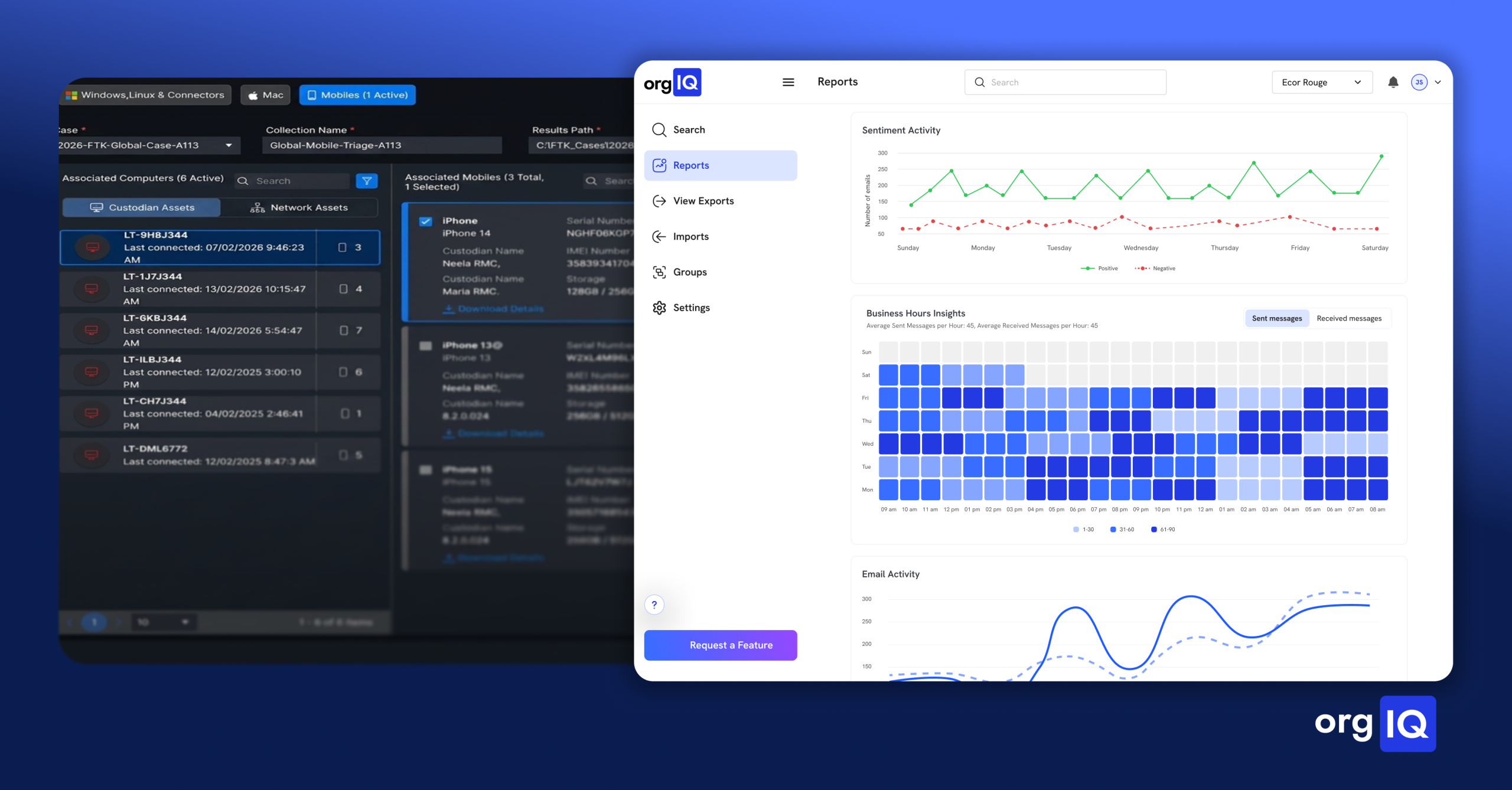
Some teams need to govern the inbox. Others need to govern an entire data estate — a distinction that’s the cleanest way to understand how Org IQ and Exterro differ.
Org IQ starts with the conversations already moving through Microsoft 365 and Google Workspace, then makes them searchable and analyzable for teams that need day-to-day visibility. Exterro starts with the legal matter, then brings preservation, collection, processing, review, and production into a broader eDiscovery workflow.
Predictably, though, there’s overlap. Both platforms preserve business communications, support legal hold, and help teams find what matters. But they’re built for different jobs.
Org IQ is the more focused fit when email itself is the source of insight: the customer complaint nobody escalated, the employee concern buried in a thread, or the response pattern quietly pointing to a larger problem. Exterro is the more expansive fit when email is one potential source of evidence among many, and the organization needs to carry a formal matter from preservation through production.
This comparison breaks down those differences across search, analytics, legal hold, workflow depth, deployment, security, pricing, and everyday usability.
How Much Compliance Software Do You Actually Need?
You can solve an email compliance problem with an email-first platform, but you probably can’t solve an enterprise discovery problem with one.
Good ESI governance is less “save everything forever” and more “keep the right records for the right reasons, then delete them on schedule.” Federal discovery rules treat electronically stored information as discoverable, and Rule 37(e) addresses the loss of ESI that should have been preserved for anticipated or ongoing litigation. Once retention periods expire and no legal hold or other obligation remains, documented policies should guide secure disposal. That makes archiving only one piece of the puzzle. Teams also need reliable legal holds, efficient review, production-ready exports, clear audit trails, and consistent disposition controls.
Org IQ and Exterro both enter the conversation here. Org IQ is built around archived email, and the insight teams can pull from it. Exterro covers a broader chain of work, from legal hold and collection through processing, review, and production. So, the buying decision comes down to scope:
“How much of the investigation or review workflow do we want one system to cover?”
Shared Email Archiving and Compliance Capabilities
Both vendors support a common baseline that reduces risk during preservation and review:
- Connectivity with Microsoft 365 and Google Workspace environments.
- Searchable access to preserved electronic communications and records.
- Legal hold software capabilities that support preservation and analysis.
- Workflow automation for monitoring, preservation, and review tasks.*
- Encryption, access controls, auditability, and compliance-focused data handling.
*Org IQ concentrates automation on archived email monitoring, recurring searches, and alerts, while Exterro extends it across legal hold, collection, processing, and review.
Where the Platforms Part Ways
Feature lists might make these platforms look more similar than they are. Undeniable gaps appear once you follow the work from collection through review.
Scope of Collection, Processing, and Review
Org IQ is email-first. It captures and indexes business email, then layers search, reporting, and AI analysis onto that archive. The platform doesn’t include document review software for multi-source enterprise matters.
Exterro is matter-first. Its eDiscovery solution covers legal hold, in-place preservation, collection, processing, review, advanced analytics, and production, with source-linked answers and full audit-ready workflows from preservation through production.
Search, Analytics, and Workflow Automation
Org IQ’s differentiator is communication intelligence inside archived email, which plays out in the form of AI-assisted search, tag-based filtering, sentiment analysis, PII detection, employee focus reporting, trend charts, and scheduled searches.
In compliance workflows, these capabilities help teams narrow large archives to relevant conversations, surface potential risk indicators, preserve context for review, and revisit recurring issues without having to conduct repeated manual searches.
Exterro’s tools are built around the wider legal matter.
Search. Teams can target data by custodian, date, keyword, or document, then index, deduplicate, filter, and cull it before review.
Analytics. Review dashboards, contextual relationship mapping, AI-generated summaries, transcription, translation, and smart labeling help teams identify, classify, and prioritize relevant material.
Workflow automation. Exterro connects those search and analysis tools to legal holds, reminders and escalations, in-place preservation, collection, processing, review assignments, privilege workflows, production, and chain-of-custody tracking.
In other words, Exterro does more than help teams find and analyze information. It orchestrates the compliance workflow around those findings
Deployment, Security, and Scalability
Org IQ is a cloud-only product with quick setup, no hardware requirements, unlimited users and archiving, and pricing based on archived data volume.
Its security posture includes a completed SOC 2 Type I audit, encryption in transit and at rest, tenant-isolated AWS infrastructure, role-based access controls, 2FA, centralized monitoring, vulnerability management, and formal incident response and disaster recovery procedures. It also supports legal holds and aligns with SEC and FINRA requirements.
Exterro publishes a broader security and deployment story, citing:
- ISO 27001,
- SOC II,
- FedRAMP,
- TISAX,
- HITRUST, and a HITRUST e1 certification for its AWS-based SaaS platform.
Deploying Exterro is typically a guided enterprise project rather than a simple plug-and-play setup. Connecting data sources, configuring roles and workflows, testing the system, and training users may involve Exterro Professional Services or an implementation partner, particularly for multi-source, on-premises, hybrid, or highly tailored environments.
Day-to-Day User Experience
Public feedback suggests that Org IQ is lighter to adopt. G2 shows a 5.0/5 rating from four reviews, with reviewers calling out ease of implementation and straightforward search.
Exterro’s review record is broader and more mixed. Capterra lists Exterro E-Discovery Software Suite at 3.8/5 from nine reviews, with praise for functionality and support in some reviews, but criticism around reporting and learning curve in others.
Feature Comparison Table
| Attribute | Org IQ | Exterro |
| Primary scope | Email archiving, organization-wide search, and communication analytics. | End-to-end eDiscovery, data-risk management, and legal workflow automation. |
| Data capture and connectivity | Real-time Microsoft 365 and Google Workspace email journaling. | 190+ connectors across email, cloud, collaboration, and enterprise sources. |
| Processing and indexing | Full-message indexing for archive search, tagging, reporting, and analytics. | Combined collection and processing within one connected workflow. |
| Review and analytics | AI search, tags, sentiment, PII detection, reports, and trends. | AI review analytics, classification, analytics, source-linked answers, and automated batching. |
| Legal hold | Immutable preservation, retention controls, search, audit history, and export. | Dedicated holds, templates, tracking, escalations, dashboards, and audit trails. |
| Workflow automation | Saved searches, scheduled searches, alerts, and recurring reports. | Automation across legal hold, preservation, collection, processing, review, and production. |
| Collaboration and permissions | Unlimited users, role-based permissions, scoped guests, and automatic expiration. | Matter permissions, outside-counsel access, review workflows, and document batching. |
| Deployment | Cloud-only; enterprise plans add dedicated servers and APIs. | Cloud, private-cloud, on-premises, and hybrid deployment options. |
| Security and compliance | SOC 2 Type I, encryption, SSO, tenant isolation, 2FA, monitoring, disaster recovery. | ISO 27001, SOC 2, FedRAMP, TISAX, HITRUST e1, encryption, logging. |
| Pricing | Published tiers, unlimited users, and storage-based searchable-data pricing. | Standard pricing unpublished; Review offers annual unlimited-user licensing. |
How Each Platform Fits Real-World Operations
HR and Internal Communication
Org IQ lines up better with HR-led reviews that start in email, such as employee complaints, handoffs, tone shifts, or sensitive data exposure. HR, managers, and leadership can search, review, and analyze those communications directly without relying on IT. Exterro can support internal investigations, but its workflow is more legal-operations-centric.
Legal and Compliance
Exterro is the stronger fit for formal discovery, large legal holds, multi-source collections, processing, review, and production. Org IQ supports legal hold and compliance-oriented email search, but its footprint is narrower and email-centered.
Client-Facing Teams
Org IQ is easier to map to sales, customer success, and executive visibility because it analyzes message history, response patterns, and sentiment inside actual business email. Exterro can collect and review those sources, but that’s usually in the context of investigation or discovery, not daily communication visibility.
Leadership and Operations
Leaders who want a searchable system of record with lighter deployment and predictable pricing will find Org IQ easier to evaluate early. Teams that want one platform spanning legal hold through production, with wide connector coverage and myriad formal security attestations, will usually lean Exterro.
Pricing, Plans, and Vendor Transparency
Org IQ publishes two pricing paths. Standard Insights and Intelligence plans are available monthly, annually, or on three-year terms, with unlimited users and total archiving; searchable-storage overages cost $0.45/GB for Insights and $0.40/GB for Intelligence, while exports cost $1/GB. New accounts on both tiers get a complimentary 30-day Intelligence trial.
For lighter or pilot use, On Demand starts at $49/month plus $0.50/GB for Insights or $0.75/GB for Intelligence.
On the main Exterro product pages, standard public pricing for the eDiscovery and legal hold suites goes unlisted. Buyers are generally directed to request a demo or contact sales. A recent official migration page mentions flat-rate pricing and pay-once data storage, but public package details remain limited.
Support and training: Org IQ is built for low-touch onboarding, with most businesses archiving within hours and larger deployments typically taking a few days. Support is available during setup and ongoing use, with priority support for Enterprise customers. Exterro includes support with subscriptions and offers structured in-person, live virtual, and on-demand training through Exterro Academy.
Summary and Takeaways
Across preservation, analytics, deployment, and workflow depth, the best fit comes down to whether your priority is accessible email intelligence or broader, matter-driven eDiscovery.
Which Platform Fits Your Workflow?
Email-centered need
Archived email preservation, organization-wide search, and communication insight.
Who needs direct access?
HR, leadership, operations, and client-facing teams.
Org IQ
Email-centered analytics, lighter deployment, cross-functional access, and transparent pricing.
Enterprise discovery need
Preservation, collection, processing, review, and production across many data sources.
Who owns the workflow?
Legal operations, compliance, privacy, and forensics teams.
Exterro
Matter-centered eDiscovery, broader workflow automation, and enterprise data-source coverage.
Frequently Asked Questions
Is Org IQ a good alternative to Exterro?
Org IQ can be a strong Exterro alternative for teams needing searchable email archiving, communication analytics, legal holds, and cross-functional access without a full eDiscovery stack. Exterro better suits broader, matter-driven workflows spanning collection, processing, review, privacy, and digital forensics.
How much does Exterro cost compared with Org IQ?
Org IQ publishes Insights and Intelligence pricing, with unlimited users, unlimited total archiving, and storage-based charges for searchable data. Exterro pricing is more nebulous, so buyers must request a quote based on deployment scope, modules, data sources, and workflow requirements.
Do I need email archiving software or eDiscovery software?
Choose email archiving software to preserve, search, monitor, and export business email. Choose eDiscovery software when legal teams must collect, process, review, and produce evidence across multiple systems, custodians, and matters. Some organizations use email archiving as an eDiscovery foundation.
Can email archiving software support legal holds and eDiscovery?
Yes. Email archiving software can support legal holds, retention, audit history, search, and defensible exports. A full eDiscovery platform would then add broader enterprise data collection, processing, review, production, custodian management, and matter workflows across email, cloud applications, collaboration platforms, and other sources.
Which platform is better for Microsoft 365 email investigations?
Org IQ is the simpler fit for full-thread search, archived email analytics, guest access, and rapid HR, legal, or management assessments. Exterro is stronger when Microsoft 365 investigations require multi-source collection, formal matter management, large-scale document analysis, and defensible production.
What is eDiscovery, and how does email archiving fit into it?
eDiscovery is the process of identifying, preserving, collecting, processing, reviewing, and producing electronically stored information for legal matters. Email archiving supports eDiscovery by retaining searchable, auditable communications and making relevant messages, attachments, and conversation history available for legal hold, investigation, and export.


