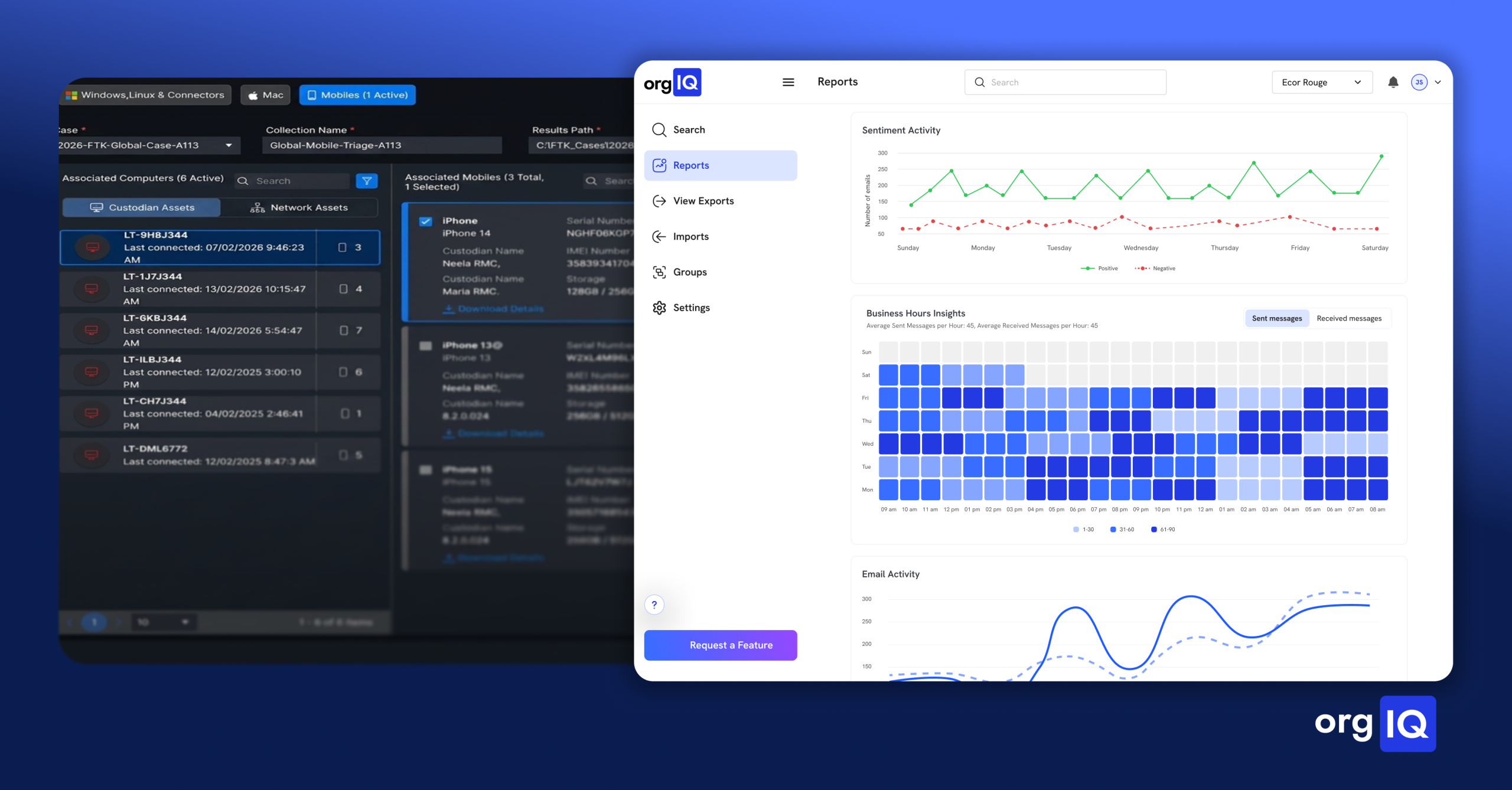
Org IQ vs timetoreply, best email archiving software for business, email archiving vs backup, email analytics vs email archiving, email response time analytics, shared mailbox reporting, SLA tracking, search archived emails across organization, email retention policy requirements, email archiving for compliance, email communication analytics, journaling-based email capture, email response time tracking software, shared mailbox response time tracking, sentiment analysis for email, email search and tagging.
timetoreply and Org IQ both help teams quantify email responsiveness, but they’re designed to achieve different outcomes.
timetoreply is an inbox-adjacent email response time tracking software, focused on reply time goals, SLA tracking, and alerts delivered where agents work. Org IQ also offers time-to-reply visibility, while placing equal weight on archiving, search, exports, and email communication analytics used by HR, Legal, and leadership.
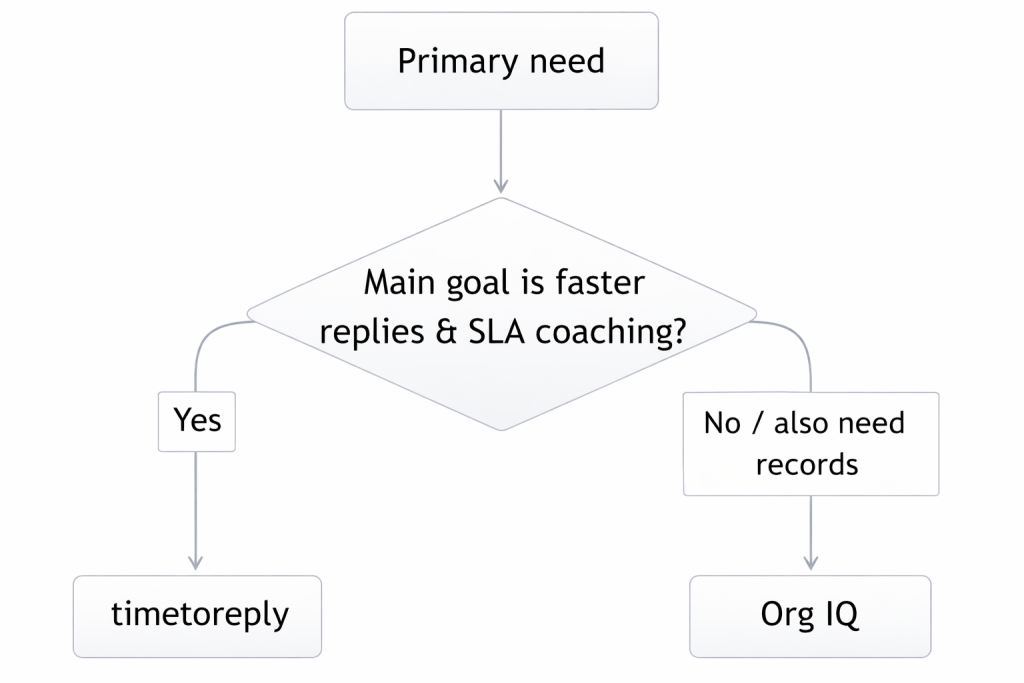
A helpful way to frame the decision: if you mainly need to improve reply performance in shared mailboxes, timetoreply should be enough. If you need to retain complete records, reconstruct full threads (including attachments), and safely share access with reviewers outside IT, Org IQ is closer to meeting that requirement set.
Why These Tools Show Up in the Same Shortlists in 2026
For customer-facing teams, response time measurement and SLA adherence tend to drive tool adoption because missed replies translate into critical service risk. At the same time, many organizations are starting to see business email as a record that must be retained and producible, which adds an archiving and export dimension to email analytics evaluations.
That cross-pressure explains why these products are compared: both can answer “How fast are we responding?” but with different rigors. And only one lets you search archived emails across organization for post-event review and production of complete records.
So… email analytics vs email archiving, which one does your team actually need?
Shared Email Visibility Capabilities
Despite different positioning, both platforms support several overlapping capabilities tied to email visibility and operational reporting:
- Direct integrations with Microsoft 365 and Google Workspace, covering Outlook and Gmail environments
- Reply time and responsiveness tracking, including shared mailbox reporting
- Segmentation of email activity, such as by customer groups, teams, or message context
- Dashboards and manager-level reporting for monitoring communication patterns
- Cloud-based deployment, with access managed across distributed teams
- Exportable reports for internal sharing and downstream analysis
So far, both tools give managers a way to see how email is being used and how quickly service teams are responding. The real differences begin to show up when you look beyond these common capabilities into depth of insight, data retention, and what each platform is built to surface over time.
How the platforms differ in practice
What each tool does with email ends up driving how it performs across reporting, access, and analysis.
Product focus and target users
timetoreply is a shared mailbox response time tracking solution for customer-facing teams that want to improve reply times and meet SLAs, with live, custom KPIs and alerts in the inbox.
Org IQ offers email archiving plus analytics, highlighting journaling-based email capture, search, reporting, and advanced analytics (such as sentiment analysis for email and PII reporting) for broader business functions.
Data scope and search experience
timetoreply ingests email header information to produce reply time and performance metrics; it doesn’t ingest bodies or attachments. As such, inbox- or thread-level search capabilities will be unavailable via the tool.
Org IQ archives full message content, so search runs across entire threads, not just metadata. Features like tag-based filtering, AI tag creation, and retroactive tagging let teams organize and revisit history without manual cleanup. Search also covers attachments and conversation context, making it easier to trace decisions end-to-end.
For HR and Legal, this supports investigations and eDiscovery. For customer-facing teams, it helps reconstruct deal cycles, spot missed follow-ups, and understand how conversations progressed over time, along with activity analytics that reveal patterns at a glance.
Reporting, integrations, and exports
timetoreply centers on reporting for reply time, SLA performance, and mailbox activity, and exports supported reports to CSV or Excel. It also markets broad workflow integration, including an integrations directory and “5,000+” integrations aligned with customer-facing roles.
Org IQ’s reporting layer goes beyond basic activity metrics to surface patterns across conversations, teams, and time. Dashboards combine email volume, business hours insights, response behavior, and sentiment signals to highlight shifts in tone, engagement, and risk, helping HR, Legal, and leadership teams spot issues early and act with context.
Reporting is paired with full-message capture, enabling analysis across complete threads rather than relying on metadata alone. Data can be exported at multiple levels, including filtered searches, full mailboxes, or attachments, in formats such as EML, MBOX, or JSON, with bulk and audit-ready export workflows built in.
Security, privacy, and service expectations
timetoreply claims SOC 2 Type II compliance and ISO 27001 certification, describes encryption at rest and in transit, and lists the header fields it ingests (to/from/cc, subject line, message IDs, timestamps). Its privacy policy also states that personally identifiable data is deleted when a subscription is canceled.
Org IQ has completed its SOC 2 Type I audit, with Type II ongoing (as of publication). It enforces strict controls, including tenant isolation, mandatory two-factor authentication, and Amazon Web Services-hosted infrastructure to securely manage the sensitive data it has access to. Account data may be retained for up to two years after termination, with archived data periodically deleted and anonymized data retained where applicable.
Third-party review signal
On Capterra, timetoreply is rated as 4.5 overall based on 42 user reviews (with separate ratings for ease of use and customer service). Users consistently describe it as an intuitive tool that gives clear visibility into email response time analytics and SLA performance, with strong support, though some note cost and usability quirks
On G2, Org IQ has received a 5/5 rating with four reviews. Users describe it as a fast, easy-to-implement platform that turns email archives into actionable insight, especially for search, knowledge retention, and faster investigations, with minimal reported downsides.
Review volume differences don’t prove product fit either way, but they might come in handy for those who depend on third-party sentiment during procurement.
Feature comparison table
| Spec | timetoreply | Org IQ |
| Teams served | Customer support, CX, sales, operations | HR, Legal, leadership, plus customer-facing teams |
| Analytics depth | Reply time, SLA, workload metrics | Sentiment analysis, PII detection, AI-powered search, behavioral patterns |
| Data retention / historical access | Operational metrics over active data | Long-term archive with historical search and retroactive analysis |
| Security & compliance posture | SOC 2 Type II, ISO 27001; not built for email archiving for compliance | SOC 2 Type I, AWS infrastructure, RBAC, etc.; journaling-based capture in line with compliance needs |
| Onboarding model | Inbox-connected SaaS; human support available | Journaling-based email capture with guided onboarding |
| Integrations | “5,000+” integrations stated | API access for enterprise clients |
| Pricing model | Per mailbox per month and annual discounts; stated mailbox minimum. Free trial available (duration not publicly specified) | Usage-based monthly pricing, annual and multi-year discounts, pay only for archived data and exports. Free 30-day trial included |
Pricing, plans, and vendor transparency
timetoreply offers per-user subscription plans starting at $29–$34/mailbox/month with a 15-mailbox minimum, enterprise tiers for 100+ users, and a Lite option for smaller teams.
Org IQ uses a storage-based pricing model tied to its platform tiers, Insights and Intelligence, with cost scaling based on archived data volume rather than user count. Both tiers are built for ongoing use and include a 30-day trial. A lower-commitment, $49 on-demand option offers limited functionality, giving teams a flexible entry point before moving to full-scale deployment.
Summary and takeaways
To wrap up, here are a few key factors most product decisions hinge on.
Usage and retention needs
timetoreply emphasizes in-inbox KPIs, alerts, and SLA-oriented reporting. The platform ingests email header data rather than bodies or attachments. This aligns with teams that want reply time coaching and visibility without storing message content in the analytics layer.
Org IQ carries out journaling-based capture, full-message archiving (including attachments), tag-based search, and controlled sharing with settings like expiring guest access. This satisfies email retention policy requirements, enabling review and investigation workflows where teams need to recover and produce complete context across departments.
Company size
If you primarily monitor a limited number of 5–15+ mailboxes, timetoreply’s per-mailbox pricing can be easy to forecast.
If you expect broad internal access across functions, Org IQ provides for unlimited users and archiving-oriented access patterns, which may be easier to extend beyond a single team.
Team structure
timetoreply aligns with coaching and accountability in customer-facing teams through inbox-level cues and response time reporting.
Org IQ aligns with cross-functional review needs, including self-serve search, full-thread context, and expiring guest access for outside reviewers.
Analytics needs
If your questions stay within reply speed and SLA breaches, timetoreply’s reporting and exports cover much of the need.
If you need email search and tagging, sentiment, PII reporting, and faster context reconstruction for reviews, Org IQ’s Intelligence-tier feature set fits that scope better.
Compliance complexity
If you must retain and produce complete records in formats aligned with retention and audit-trail expectations (for example, WORM or an equivalent audit-trail requirement), an archiving system becomes a functional requirement.
timetoreply’s platform centers on header analytics, while Org IQ’s provides archiving, search, and export. Teams in the market for email archiving vs backup tools will be glad to know that the former is Org IQ’s bread and butter.
Frequently asked questions
Does timetoreply read email content or just metadata?
timetoreply ingests header data (such as sender, recipient, timestamps, and subject lines) to generate response time and SLA metrics, without storing full message bodies or attachments.
Can Org IQ search full email conversations across the organization?
Yes. Org IQ archives full message content, enabling search across threads, attachments, and historical conversations, with tagging and filtering layered on top. You might find it in comparisons of the best email archiving software for business, and its applicability depends on your needs.
Which platform is better for SLA tracking and reply time coaching?
timetoreply is designed for this exact use case, with in-inbox KPIs, alerts, and reporting focused on response speed and accountability.
Which platform is better for investigations or audits?
Org IQ is built for this, with journaling-based capture, full-message retention, and export workflows that support review and production of complete records.
How does pricing scale with team size?
timetoreply scales with the number of monitored mailboxes, while Org IQ scales with the volume of archived data.
Want to see how Org IQ works day to day? Start with our demos and industry-tailored materials, or reach out if you’d like to walk through your specific use case together.