Why This Vendor Comparison Matters Today
The email archiving market is changing. Regulators still expect SEC 17a-4, GDPR, FINRA, and HIPAA-compliant email archiving. However, modern teams want more: visibility into culture, customer friction, and performance signals hidden in email.
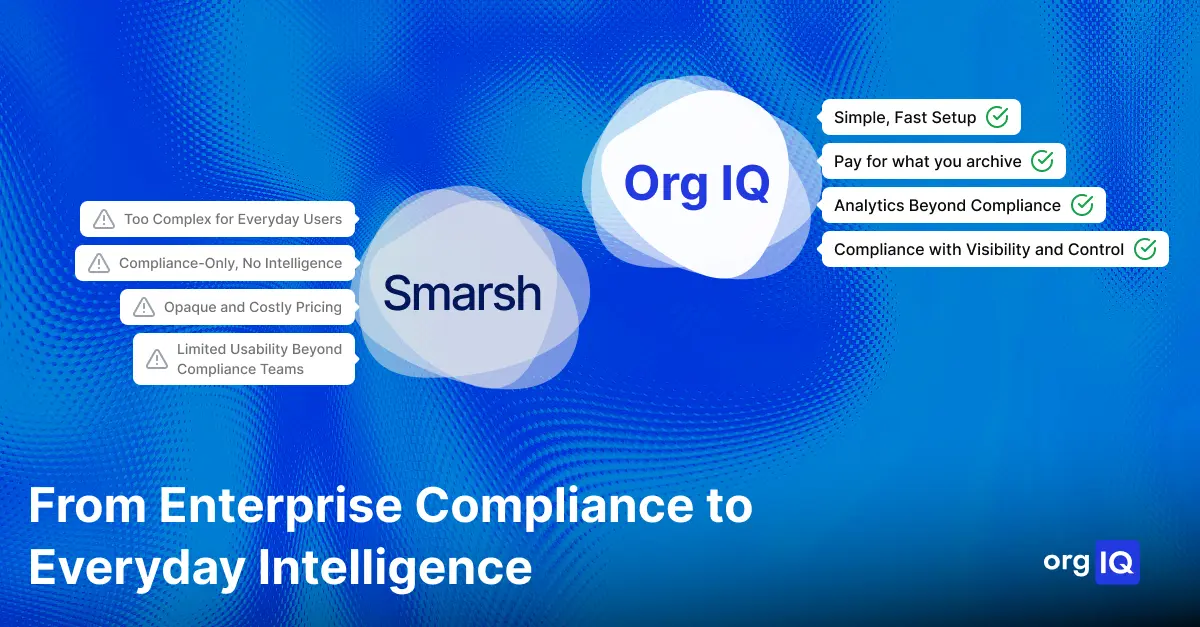
Smarsh has built its reputation serving the largest banks, broker-dealers, and investment firms. But smaller orgs rarely have armies of legal and tech officers to run it. That’s where Org IQ comes in, purpose-built to give SMBs and MSPs the same confidence, without the extra overhead.
Each Solution’s Core Archiving Features
Both tools provide full journaling capture (inbound/outbound/internal), tamper-proof, encrypted storage, and legal hold and retention policy enforcement.
Let’s map out their foundational archiving offerings.
| Feature | Smarsh | Org IQ |
| M365 and Google Workspace integration | ✅ | ✅ |
| Role-based search for every team and department | ⚠️ IT-heavy | ✅ Self-serve |
| Metadata & attachment indexing | ✅ Fully preserved | ✅ Yes, with added analytics context |
| Deployment model | Cloud-native (supports hybrid capture) | 100% cloud-native, lightweight setup |
At this stage, it’s a coin toss. Both are similarly capable, with the better fit hinging on your business’s needs and tech stack. So where do they diverge?
1. Set-Up and Integration: Bundled vs. Flexible
Archiving with Smarsh rarely comes à la carte. The Professional Archive is bundled with supervision and data export, while its governance model ties capture to policy enforcement and oversight across 100+ channels.
For a bank, this package is a feature-rich, worthwhile investment. But for a 200-person firm? It can be overkill.
- Integration demands: IT teams must configure connectors, retention policies, and compliance settings across multiple modules.
- User onboarding: Admins report that interface usability lags behind modern SaaS, making retrieval less intuitive for non-technical staff.
- Contractual friction: Multi-year contracts and unclear bundle pricing create hesitation for mid-market buyers who want agility.
This approach cements Smarsh’s reputation as an enterprise compliance powerhouse, but it makes simple business visibility harder to achieve.
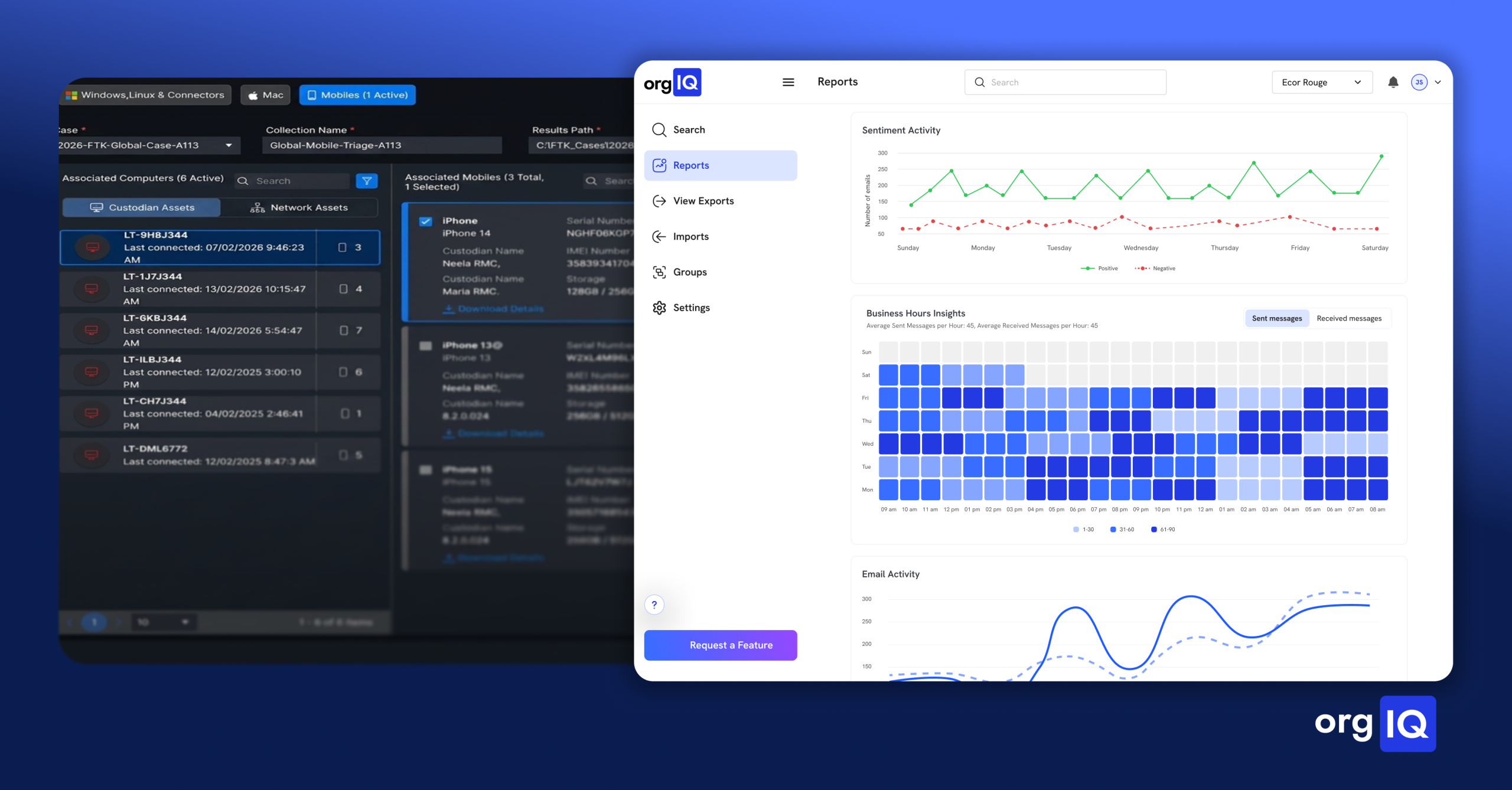
Org IQ takes the opposite path: archiving as a baseline, email analysis for small business as the differentiator. Every email is captured, yes, but the real value comes from:
- Stupidly simple dashboards
- Sentiment analysis to surface culture risks early.
- Deal-flow visibility so sales leaders can see which contracts are signed (or stuck).
- Centralized HR and Leadership dashboards that cut through blind spots without pulling in IT.
This analytics-forward take means businesses aren’t just compliant. They’re more intelligent by default.
2. Pricing and Transparency
Smarsh’s enterprise roots, client base, and complexity come to the fore when numbers enter the conversation.
Smarsh: Enterprise-Grade, Enterprise-Priced
Public pricing details are scarce as Smarsh does not publish rates, but customer reviews consistently cite expensive bundles, a lack of “just archiving” tiers, and aggressive lock-in when businesses attempt to export their archives.
For example, one small business reported that Smarsh’s per-user fees nearly tripled within months as unauthorized services were quietly added to their bill. When they tried to exit, Smarsh allegedly withheld access to their own archived emails unless a ransom-like payment was made, despite no such charges being in the contract.
Org IQ: Usage-Based Simplicity
Org IQ publishes transparent email archiving pricing. Customers pay only for what they store or export, no bundles, no forced add-ons. This aligns with how SMBs and MSPs actually buy: flexible, predictable, and ready to scale.
| Feature | Smarsh | Org IQ |
| Public Pricing | ❌ Hidden, bundled | ✅ Transparent |
| Usage-Based | ❌ Enterprise contracts | ✅ Pay for what you archive |
| SMB Fit | ❌ Secondary | ✅ Core clientele |
3. Analytics and Insights: A Clear Divide
Smarsh markets “AI-powered communications surveillance” through its Enterprise Conduct suite, built to reduce false positives in supervision alerts, surface regulatory risks, and streamline FINRA/SEC audit trails.
Reporting is geared toward compliance teams (message volumes, supervision queues, exception handling) with customization for audits and legal review.
What’s absent is evidence of broader workforce analytics: no sentiment tracking, no visualization of organizational message networks, and no HR-ready dashboards that surface cultural risks, engagement patterns, or performance signals. In practice, the data remains locked in a compliance lens.
Meanwhile, Org IQ goes beyond recordkeeping or basic compliance surveillance to deliver email archiving with analytics that leadership teams can act on.
In addition to role-based reporting for Legal and Compliance, Org IQ surfaces:
- Sentiment trends across departments and teams
- Organizational communication maps to reveal collaboration strengths and silos
- Employee Focus Reports and HR-ready insights for culture, complaints, and offboarding risks
- Customer and sales signals tied to responsiveness, deal health, churn risks, and retention opportunities.
It’s the difference between compliance reporting that tells you what happened and intelligence analytics that tell you how it happened, and why it matters.
4. Deployment and Integration
Smarsh doesn’t take a one-size-fits-all approach. Instead, onboarding is tiered, with different levels of guidance.
Here’s a rundown of the onboarding services Smarsh offers incoming businesses:
- QuickStart: Largely email-guided. Suited for very small firms with straightforward setups.
- Standard: Web conference-based guidance with some live support.
- Advanced: A dedicated Smarsh Project Manager leads the process end-to-end.
- Custom: Fully tailored deployments, often involving remote or on-site consulting.
This flexibility is designed to serve everyone from small practices to large, regulated enterprises. But it also means that for many SMBs, even a “Standard” onboarding may feel heavier than expected. Planning, configuration, directory connectors, and IT sign-off are often unavoidable steps.
Put simply, the bigger your environment, the more complex the lift… and the more dependent you become on Smarsh’s project managers and IT bandwidth to streamline the transition.
Org IQ: “Switch On, Sit Back”
Org IQ strips away that weight. As a cloud-native email archiving platform, integration with M365 and Google Workspace takes minutes, not weeks, with no MX record changes and zero reliance on third-party migration tools.
What businesses usually notice right away:
- Self-serve dashboards that make IT hand-holding optional.
- Seamless onboarding supports Microsoft and Google SSO, multi-org switching, and time-limited Guest roles to keep access both simple and secure.
- Full and fast journaling capture from day one, ensuring nothing slips through during setup, and you experience zero workflow disruptions.
Whether you’re ten seats or five hundred, you get the same frictionless deployment, and your team can start searching, reporting, and surfacing insights almost immediately.
5. Retrieval and Day-to-Day Use
Smarsh’s retrieval excels at compliance, capturing full conversations, indexing them for search, and enabling exports that regulators trust. Internal staff can also access a Personal Archive via the platform or Outlook, supporting self-service retrieval.
However, usability feedback is mixed. While searches return complete records, reviewers report that results can be slow, clunky, or inaccurate, particularly on mobile or Bring Your Own Device (BYOD) setups. Even technically adept users cite a steep learning curve, with workflows geared more toward supervision and eDiscovery than everyday business use.
A further drawback is the lack of seamless external sharing, since guest access requires IT setup or formal account provisioning.
With Org IQ, retrieval is search-driven and instant. And leaders can grant guest access to outside counsel or partners in seconds without the IT bottleneck. The difference is in end-user friendliness: compliance is built in, but usability is prioritized.
6. Compliance Reputation
This is where Smarsh shines. They have a strong compliance pedigree, particularly in the financial and legal sectors. The brand is widely recognized for helping firms meet SEC, FINRA, and MiFID II requirements. For businesses under constant regulatory scrutiny, this reputation is a core selling point.
Org IQ shares this compliance baseline but goes beyond it: not just “store until asked,” but also real-time visibility into communication risks before they escalate.
So, Which Is the Best Email Archiving Solution for Small Businesses?
Smarsh is built for enterprises with deep pockets and strict regulatory exposure, especially in finance. If you’re a broker-dealer or global bank, its compliance-first pedigree may be worth the complexity.
But if you’re an SMB, MSP, or mid-market firm that values analytics, ease of use, and transparent pricing, Org IQ provides a smarter, more accessible alternative, transforming archiving from a regulatory checkbox into a source of actionable business intelligence.